
- Home
Edition
Africa Australia Brasil Canada Canada (français) España Europe France Global Indonesia New Zealand United Kingdom United States Edition:
Global
Edition:
Global
- Africa
- Australia
- Brasil
- Canada
- Canada (français)
- España
- Europe
- France
- Indonesia
- New Zealand
- United Kingdom
- United States
Academic rigour, journalistic flair
 Protesters take part in a climate protest march in Ottawa, on Sept. 21, 2024.
THE CANADIAN PRESS/Spencer Colby
Youth Climate Corps: Young Canadians need more action and less tokenization
Published: December 1, 2025 7.12pm GMT
Lilian Barraclough, University of Guelph
Protesters take part in a climate protest march in Ottawa, on Sept. 21, 2024.
THE CANADIAN PRESS/Spencer Colby
Youth Climate Corps: Young Canadians need more action and less tokenization
Published: December 1, 2025 7.12pm GMT
Lilian Barraclough, University of Guelph
Author
-
 Lilian Barraclough
PhD Student, Social Practice and Transformational Change, University of Guelph
Disclosure statement
Lilian Barraclough receives funding from the Social Sciences and Humanities Research Council of Canada. She is the Co-Chair of the Board of Directors of the Youth Climate Lab and a regional representative for Ontario on the Young Greens Council of Canada and Youth Representative on the Green Party of Canada's federal council.
Partners

University of Guelph provides funding as a founding partner of The Conversation CA.
University of Guelph provides funding as a member of The Conversation CA-FR.
View all partners
DOI
https://doi.org/10.64628/AAM.6mxthhd7e
https://theconversation.com/youth-climate-corps-young-canadians-need-more-action-and-less-tokenization-270050 https://theconversation.com/youth-climate-corps-young-canadians-need-more-action-and-less-tokenization-270050 Link copied Share articleShare article
Copy link Email Bluesky Facebook WhatsApp Messenger LinkedIn X (Twitter)Print article
Youth engagement is critical in the fight for a just and sustainable future. And creating opportunities for young people is a vital part of a just transition away from fossil fuels.
The Canadian government’s 2025 federal budget has emphasized creating new opportunities for young people by establishing a Youth Climate Corps, providing employment placements in renewable energy, protecting biodiversity and retrofitting buildings. The government promised to invest $40 million over two years starting in 2026-27.
However, while the creation of the Youth Climate Corps is an encouraging step toward a more sustainable, equitable and resilient country, the 2025 budget simultaneously caters to the oil and gas industry, reducing requirements for urgent emissions reduction and increasing subsidies supporting oil and gas production.
Scientists have called for urgent and rapid cuts to fossil fuel production and emissions for decades in order to avoid the worst consequences of the climate crisis. While Prime Minister Mark Carney has declared that Canada remains on track to meet the emissions reductions targets set out in the Paris Climate Agreement, the expansion of oil and gas brings this into question.
One of the leading causes of climate grief and anxiety among young people is government inaction, in Canada and elsewhere, that has led to feelings of betrayal, anger and despair about climate change.
In our research, colleagues and I have found that young Canadians are experiencing intense emotions related to the climate crisis, and they often have little to no hope for the future, envisioning apocalyptic conditions for themselves and their children.
Eco-anxiety
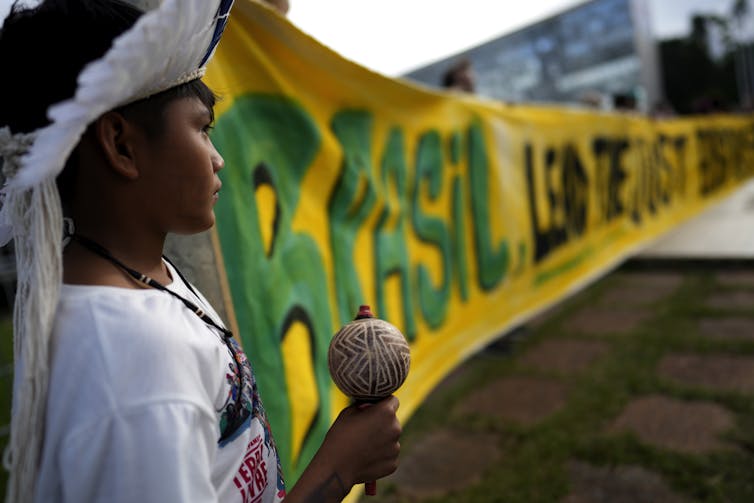 An Indigenous youth takes part in a demonstration to pressure leaders to implement a just energy transition and to phase out fossil fuels, ahead of the country hosting the COP30 climate summit, in front of the Itamaraty Palace, in Brasilia, Brazil, in April 2025.
(AP Photo/Eraldo Peres)
An Indigenous youth takes part in a demonstration to pressure leaders to implement a just energy transition and to phase out fossil fuels, ahead of the country hosting the COP30 climate summit, in front of the Itamaraty Palace, in Brasilia, Brazil, in April 2025.
(AP Photo/Eraldo Peres)
Although I am now a researcher, I have been involved in environmental and climate action since I was a child. I have witnessed the never-ending cycle of false commitments and lack of follow-through on the climate crisis.
Climate grief refers to grief in response to the losses caused by climate change — of trees, animals, place, homes as well as more intangible elements of culture and connection. Climate or eco-anxiety is defined by the American Psychological Association as “a chronic fear of environmental doom.”
Young Canadians describe their grief in visceral, embodied ways, emphasizing how their concerns about climate change invade their daily lives, relationships and life choices.
In our research, politically active youth expressed anger, frustration and hopelessness at the state of inaction on the climate crisis.
As one participant told us:
“There are times youth lose hope, when you try to push for something and then you have government push back and they just don’t get it when it makes so much sense to you that our climate is changing and we need to do something about it. Why would you not listen? Why aren’t you doing this?”
Youth need genuine engagement
 A person holds a sign that reads ‘no more bla bla bla’ during a youth climate demonstration at the COP30 UN Climate Summit on Nov. 14, 2025, in Belem, Brazil.
(AP Photo/Joshua A. Bickel)
A person holds a sign that reads ‘no more bla bla bla’ during a youth climate demonstration at the COP30 UN Climate Summit on Nov. 14, 2025, in Belem, Brazil.
(AP Photo/Joshua A. Bickel)
It’s critical to involve more young people in the sectors addressing climate change and create better employment opportunities while building capacity to respond to increasing pressures from the realities of the climate crisis. The Youth Climate Corps is an important step in that direction.
The challenge, however, is that when youth are left out of the decisions that truly influence Canada’s ability to reduce emissions, address biodiversity loss and adapt to the changes we face, it reinforces feelings of betrayal and grief.
Models of youth-adult partnership on climate action show that the most important outcomes come from positive, meaningful youth engagement. These models, when paired with the real-world experience of youth activists, make it clear that both youth and their adult counterparts — in this case government decision-makers — have a responsibility to ensure that climate action is implemented in an intentional, thorough and meaningful way.
When youth are engaged in climate decision-making but the impact on overall action to address the crisis is negligible, it can reinforce and exacerbate climate grief and anxiety.
I see many of my peers facing an impossible job market, forced to take under-paying jobs that don’t align with their values and desires for change. The Youth Climate Corps undoubtedly represents progress, but the recent federal budget investment is limited. It will create few jobs and likely won’t meet the demands of young Canadians.
Limited progress in green jobs for young people doesn’t make up for Canada’s failure to reduce emissions and hold the fossil fuel industry accountable, making young Canadians question whether the federal budget is really one of “generational investment.”
Without inclusive decision-making and concrete action, young people will continue to feel grief and anxiety over the climate crisis and its impact on their health, well-being, jobs and future prospects.
- Climate change
- youth climate activism
- climate despair
- 2025 budget
- federal budget 2025
Events
Jobs
-
 Senior Lecturer, Clinical Psychology
-
University Lecturer in Early Childhood Education
-
Case Specialist, Student Information and Regulatory Reporting
-
Lecturer in Paramedicine
-
Associate Lecturer, Social Work
 Senior Lecturer, Clinical Psychology
 University Lecturer in Early Childhood Education
 Case Specialist, Student Information and Regulatory Reporting
 Lecturer in Paramedicine
 Associate Lecturer, Social Work
- Editorial Policies
- Community standards
- Republishing guidelines
- Analytics
- Our feeds
- Get newsletter
- Who we are
- Our charter
- Our team
- Partners and funders
- Resource for media
- Contact us
-
-
-
-
Copyright © 2010–2025, The Conversation