He differs from most conceptual artists and their self-imposed strategies: even when he follows the rules, he undermines himself.
 John Yau
December 1, 2025
— 4 min read
John Yau
December 1, 2025
— 4 min read
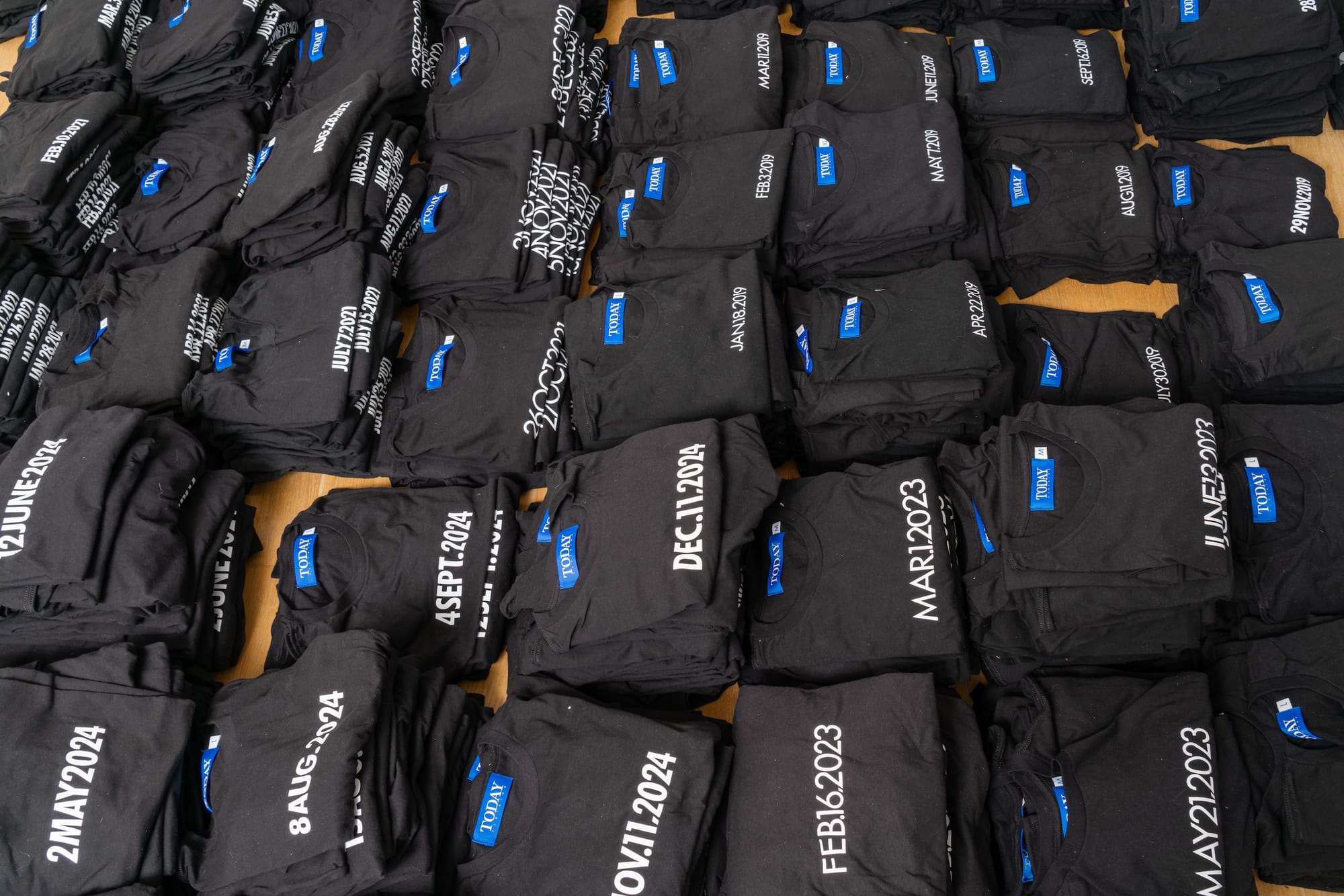
 Installation view of Tongji Philip Qian's Perfect Days series (2023–ongoing) at the Reva and David Logan Center for the Arts at the University of Chicago (all images courtesy Logan Center for the Arts)
CHICAGO — Other than a brief introductory email exchange, I knew nothing about Tongji Philip Qian when I visited Alloyed Commitments at the University of Chicago’s Logan Center for the Arts. Based on the solo exhibition, curated by Andrew Witkin, I would describe Qian as a conceptual artist whose practice takes place at the intersection of legibility and illegibility, purposefulness and futility, while working within pre-established blocks of time — something he consciously shares with the late Japanese conceptual artist On Kawara. As dry as this might sound, Qian’s practice is not without humor — through this, he undoes conceptual art’s seriousness and brings doubt into its execution.
The first work I encountered in the gallery was Perfect Days, an ongoing project begun in 2023. Rows of folded, stacked black t-shirts lay on the floor of a narrow, cordoned-off alcove. On each shirt was a date printed in white. The formatting of the dates, all written in English, was not uniform (some months were written out, others abbreviated; in some, days preceded months, and vice versa). This lack of consistency can be read as a comment on Kawara’s series Today, begun in 1966 and comprised of more than 2,000 oil paintings whose content was the date on which the work was started and completed. Operating within a strict set of self-imposed rules, Kawara always rendered the date in the language and format of the country in which he made the painting.
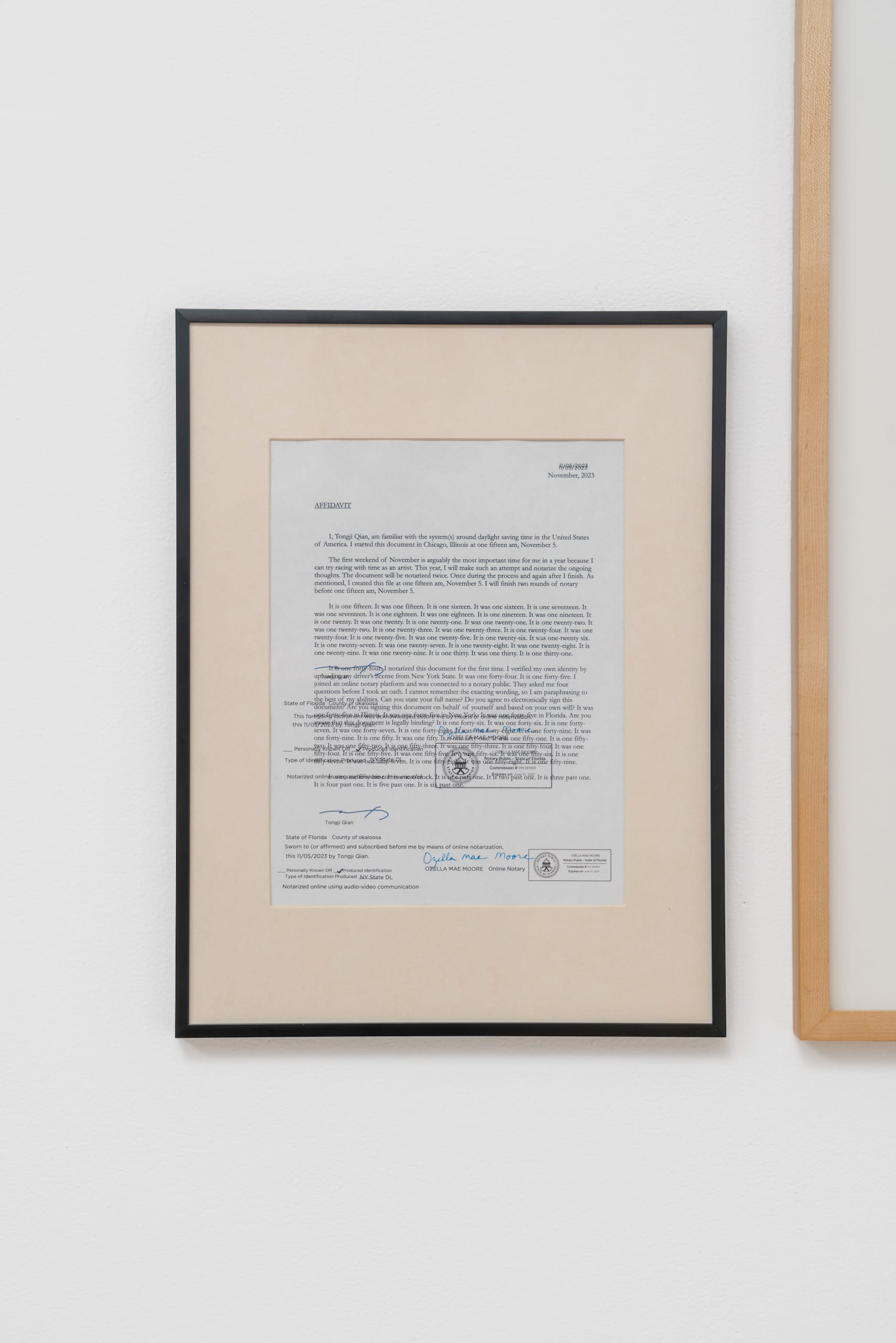 Tongji Philip Qian, "No-risk Hours V" (November 2023), ink on paper
Kawara left nothing to chance. In contrast, Qian began his series when his wife told him about the store Today Clothing in Ann Arbor, Michigan, and he convinced them to periodically lend their stock, which he returns after including it in an exhibition. Chance thus played a role in Qian’s decision to display them, thus opening conceptual art’s reliance on rules, definitions, and measurements.
Chance plays a role in the two-channel video “Finding the Spiral Jetty” (2024) as well. Qian attached two small cameras to his dog, Grappa, one on his back and the other on his belly, and let him run unleashed on Robert Smithson’s famous earthwork, which juts out into Utah’s Great Salt Lake, and is not always visible. Qian’s video is a funny and subversive homage, and a fresh and unlikely view of this iconic earthwork. You never see its entirety — only herky-jerky close-up views projected on two screens, placed on the floor against the gallery wall, as Grappa runs this way and that over the sculpture’s rocky terrain.
In No-risk Hours, an ongoing series dating back to 2019, Qian creates a drawing during the hour “saved” when clocks are turned back on the first Sunday in November; a notarized affidavit attests to this fact. Qian’s printed sheet of authenticity is ironic: Notaries sign documents but they are not to read them because it is an invasion of privacy.
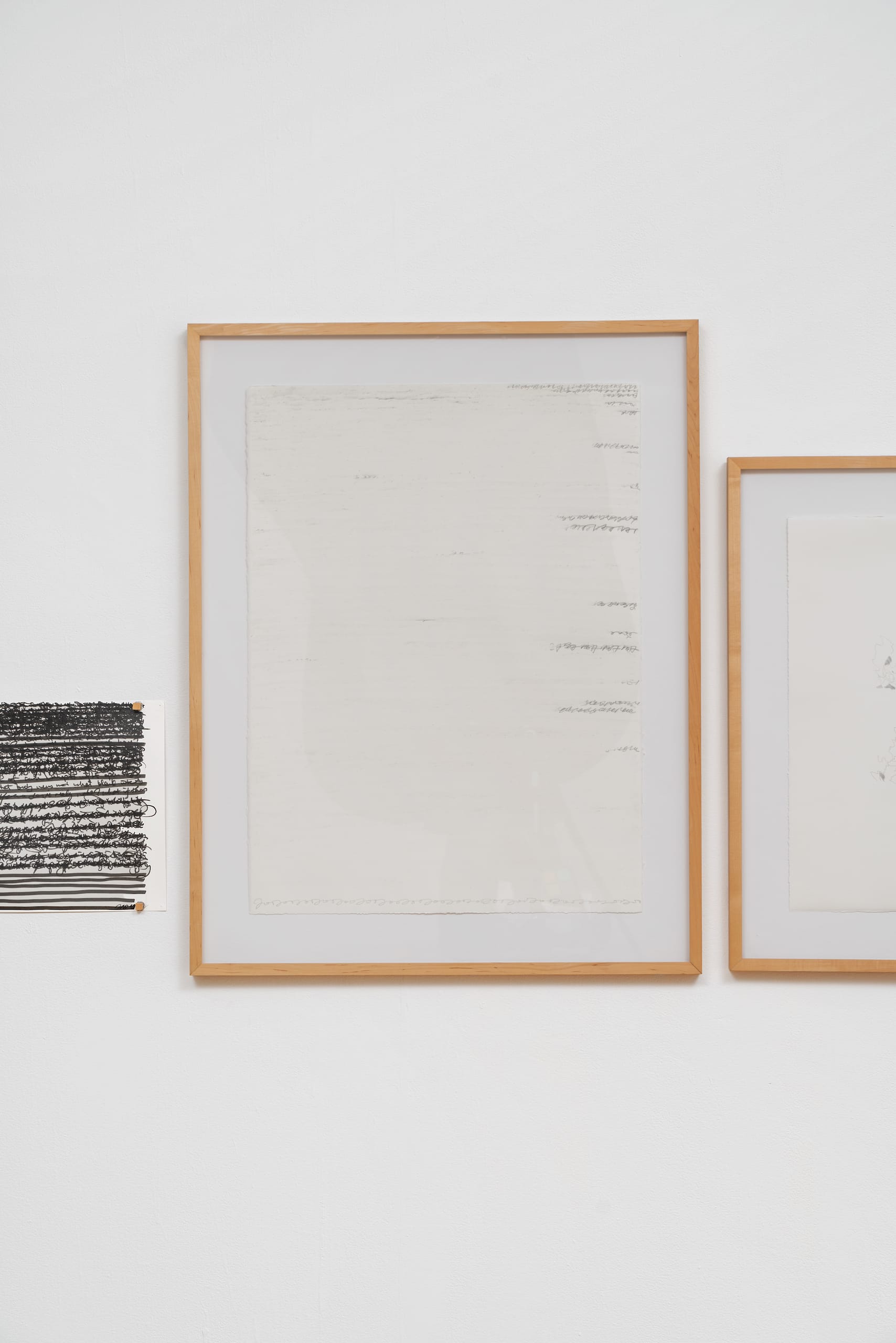 Installation view of works from Tongji Philip Qian's No-risk Hours series (2019–ongoing)
The first generation of conceptual artists dissected and analyzed language’s limitations with the gravity of a brain surgeon. Qian does the opposite. His sense of humor adds another level of meaning into his work, while it offsets the didactic solemnity we often associate with artists such as Mel Bochner and Joseph Kosuth.
Qian’s process is one of addition and subtraction. His approach to negation and alteration changes in different bodies of work, evoking his bi-cultural awareness — his Chinese origins (he was raised in Shanghai) and the years he has lived in the United States, where he currently teaches at the University of Chicago. His aesthetic is rooted in the intersection of calligraphy and writing: for instance, he has drawn vertically and horizontally in the same series, resulting in densely layered asemic works.
Ultimately, Qian’s act of writing and erasing denies self-expression. Through his time-based limitations, such as producing a drawing during his lunch hour, he conveys time as a form of imprisonment we cannot escape. The modestly sized sheets of paper he often uses further undermine assumptions that adhere to conceptual art, about the necessary size of a work and what makes it a success. By following their self-imposed rules, conceptual artists (with the exception of Sol LeWitt) could not make a failed piece. Qian does something different — even when he follows the rules, he undermines himself through erasure and negating marks. His process recalls lines from Samuel Beckett’s 1983 novella Worstword Ho: “Try again. Fail again. Fail better.” By working this way, Qian opens conceptual art to new possibilities.
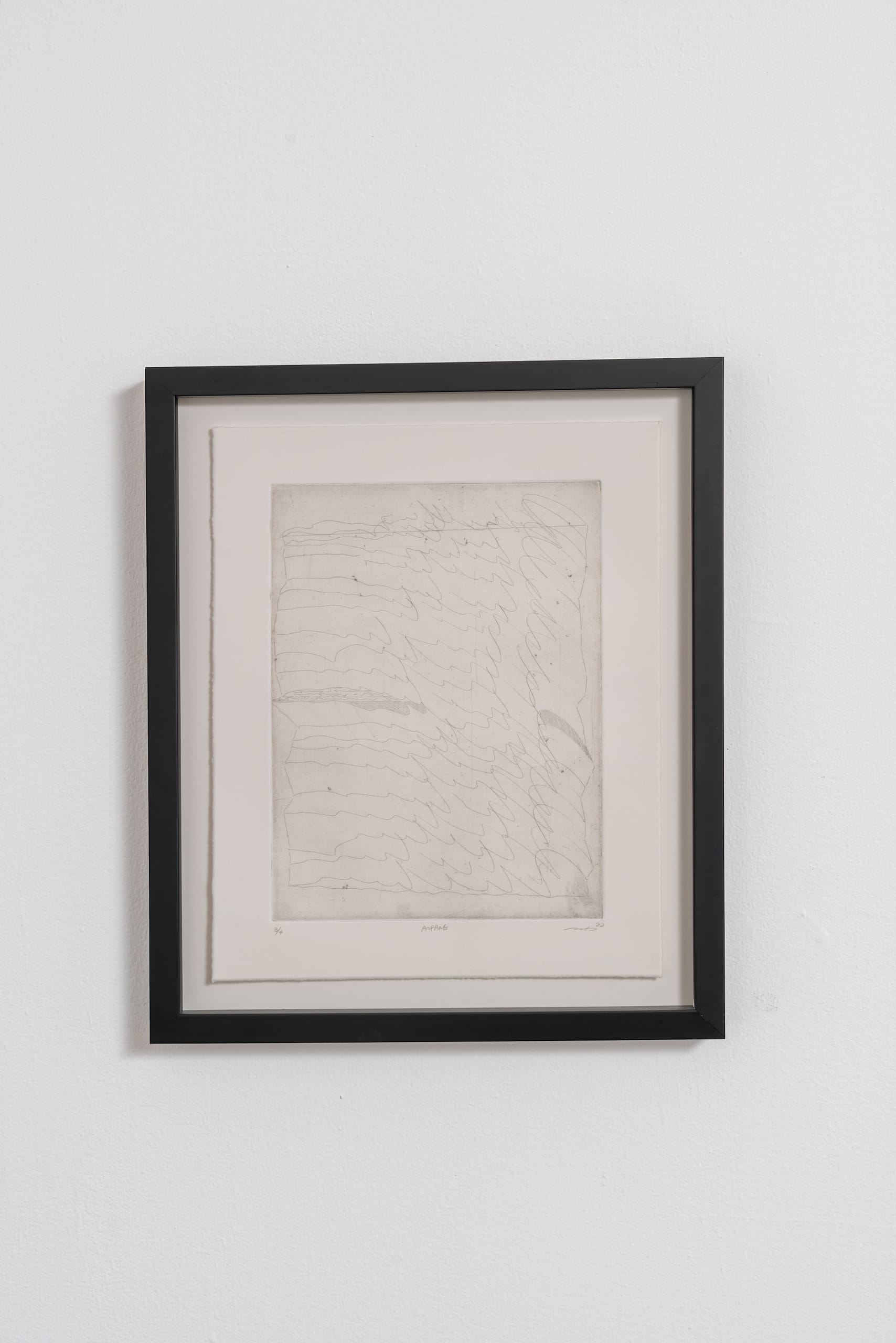 Tongji Philip Qian, "Anfang" (2022), etching
Tongji Philip Qian: Alloyed Commitments continues at the Reva and David Logan Center for the Arts (915 East 60th Street, Chicago, Illinois) at the University of Chicago through December 7. The exhibition was curated by Andrew Witkin.