
 By
Gregory Nussen
Published 15 minutes ago
Gregory Nussen is the Lead Film Critic for Screen Rant. They have previously written for Deadline Hollywood, Slant Magazine, Backstage and Salon. Other bylines: In Review Online, Vague Visages, Bright Lights Film Journal, The Servant, The Harbour Journal, Boing Boing Knock-LA & IfNotNow's Medium. They were the recipient of the 2022 New York Film Critics Circle Graduate Prize in Criticism, and are a proud member of GALECA, the Society of LGBTQ Entertainment Critics. They co-host the Great British Baking Podcast. Gregory also has a robust performance career: their most recent solo performance, QFWFQ, was nominated for five awards, winning Best Solo Theatre at the Hollywood Fringe Festival in 2025.
Sign in to your ScreenRant account
Summary
Generate a summary of this story
follow
Follow
followed
Followed
Like
Like
Thread
Log in
Here is a fact-based summary of the story contents:
Try something different:
Show me the facts
Explain it like I’m 5
Give me a lighthearted recap
By
Gregory Nussen
Published 15 minutes ago
Gregory Nussen is the Lead Film Critic for Screen Rant. They have previously written for Deadline Hollywood, Slant Magazine, Backstage and Salon. Other bylines: In Review Online, Vague Visages, Bright Lights Film Journal, The Servant, The Harbour Journal, Boing Boing Knock-LA & IfNotNow's Medium. They were the recipient of the 2022 New York Film Critics Circle Graduate Prize in Criticism, and are a proud member of GALECA, the Society of LGBTQ Entertainment Critics. They co-host the Great British Baking Podcast. Gregory also has a robust performance career: their most recent solo performance, QFWFQ, was nominated for five awards, winning Best Solo Theatre at the Hollywood Fringe Festival in 2025.
Sign in to your ScreenRant account
Summary
Generate a summary of this story
follow
Follow
followed
Followed
Like
Like
Thread
Log in
Here is a fact-based summary of the story contents:
Try something different:
Show me the facts
Explain it like I’m 5
Give me a lighthearted recap
Little Trouble Girls is a film about bodies: how we discover them, how we control them, how we deal with those who tempt them. In Urška Djukić's startling feature debut, sixteen-year-old Lucia (Jara Sofija Ostan) must learn what of herself is hers, and when — if ever — she shares with others. At turns heartbreaking in its acuteness, at others exhilarating in its access to the dangers of pleasure, Djukić's is a rare kind of coming-of-age film. It is langorous in delivery, yet fast like lightning when it lands.
A lot of these images are familiar. Djukić and cinematographer Lev Predan Kowarski photograph Georgia O'Keefe-like flowers in bloom, sensual cross-sections of fingers and mouths, ruddy cheeks, tall grasses, Persian rugs suggestive of female genitalia. There's always the chance that the film might overdo it in its suggestion of sexuality, yet, like its protagonist just stepping into a world of self-satisfaction, it always escapes the actual act. Like Call Me By Your Name by way of Whiplash, Djukić's film is a portrait of queer and artistic growth in both titilating and dangerous detail.
In this way, Little Trouble Girls is an admirably restrained piece of art. Djukić remarkably immerses her audience in Lucia's experience through a mixture of sharp sound design and infrequent, yet powerful use of point of view. Formally, the film is structured with her burgeoning sexuality in mind, the mind of a young adult whose eyes are being opened at the same time as she is being demanded to control where they look.
Lucia is a member of her high school church choir in Ljubljana, Slovenia. A shy, innocent kid who shudders at the mention of anything potentially "sinful," Lucia is mostly looked after by her stringent, conservative mother Nataša Burger, who berates her for coming home with lipstick on. In choir practice, Lucia is randomly placed next to Ana-Maria (Mina Švajger), a senior, who is every bit the precocious and promiscuous person Lucia is not; the lipstick was hers, applied by her fingers. "I can put it on you, if you like," she flirtatiously offers.
The choir is heading to Cividale del Friuli, Italy, for a three-day retreat. A small town with a medieval center, it sits about two hours from the Slovenian border, but it might as well be another world entirely for Lucia. Away from the pressures of home and afforded sudden, albeit limited, free movement, she is introduced by Ana-Maria and her friends to the possibilities of experiences beyond the Word of God. Her older friends introduce her to Truth or Dare, the very concept of sex for pleasure, and small acts of rebellion — like stealing a shirt belonging to a construction worker (Matia Casson), bathing nude in the river.
Through Djukić's empathetic direction, the young women explore themselves before exploring others. It is a singularly gentle entry point into female and sapphic pleasure.
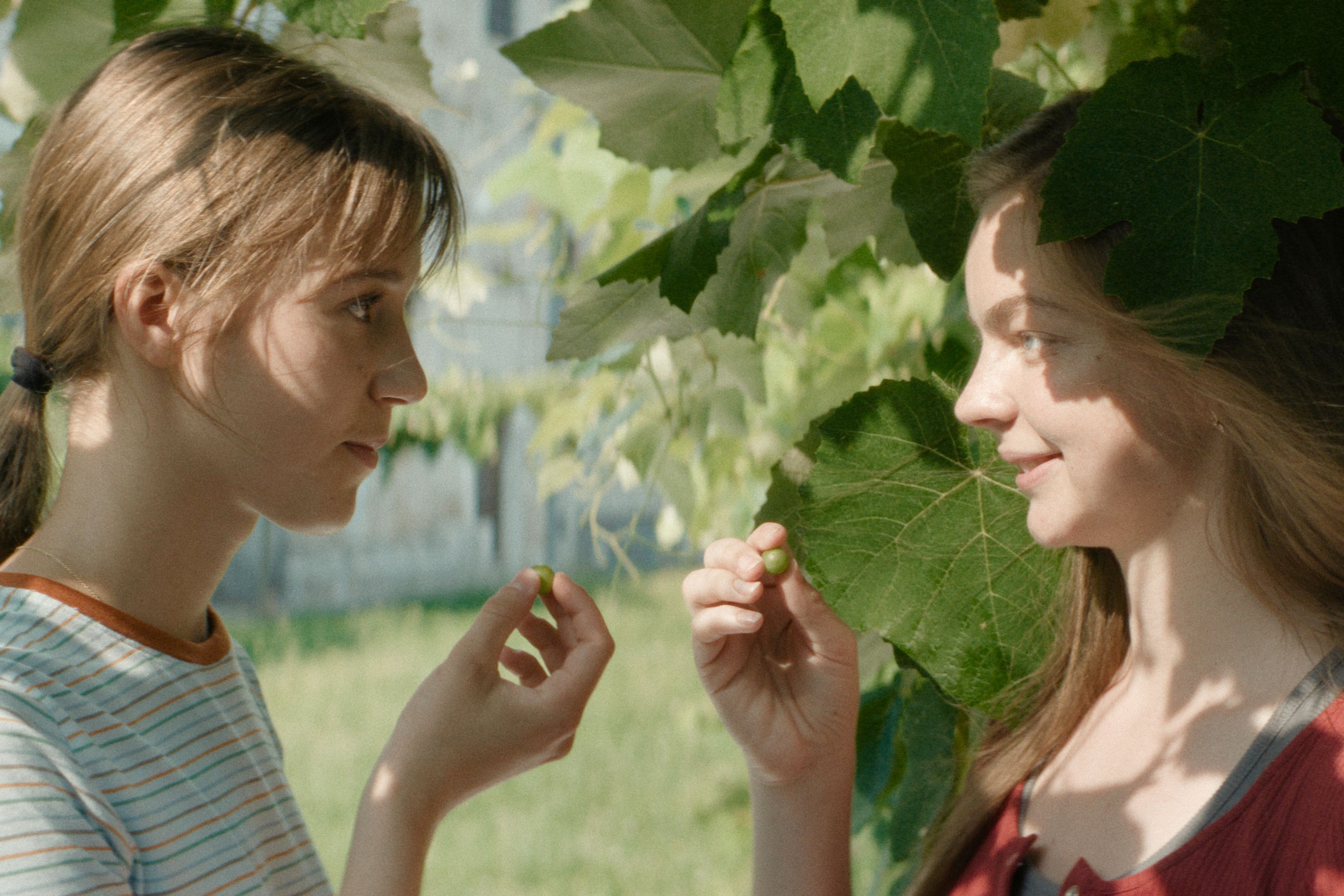
While watching the workers lounge by the shore, Ana-Maria shows Lucia how to practice kissing on her own hand before kissing her directly. Through Djukić's empathetic direction, the young women explore themselves before exploring others. It is a singularly gentle entry point into female and sapphic pleasure. Yet, all is not perfect for these kids, surrounded as they are by religious constriction both literal and figurative. When, after stealing the construction worker's shirt, Ana-Maria suggests the two of them eat sour grapes as a means of "erasing" the sin, the Biblical act seems to only spark more sexual feeling.
Though Lucia is inexperienced, she is also the only one here that is earnestly exploring. Ana-Maria selfishly plays with sexuality like a game, while their choir conductor (Saša Tabaković) clearly harbors some confusing desires of his own. In language and in design, Little Trouble Girls illustrates the harsh pulling-apart of developing queer feelings within an atmosphere defined by antiquated ideas of gender and sex. Ostan is beautifully vulnerable as Lucia, allowing us to feel, as she does, the push and pull of exploding sensations for a girl of her age with interests as far-ranging as this.
Djukić, whose previous work is defined by a predilection for multimedia, utilizes a tapestry of hyper-focused sound and extreme close-ups to clue us into the rapid development of her young protagonist. The irony is clear here: as Lucia is asked to have a level of mastery over her singing voice she could not possibly yet have, she is also implicitly asked to balance the naturalness of her desires with the supposed requirements from the Lord.
As Lucia tries to balance herself, she is plagued by the sensuality of breath around her in choir practice, the persistence of whispered voices in her head, and the inadvertently suggestive language of the religion to which she belongs. As Djukić's delightfully simple ending instructs, perhaps finding balance is not about shutting something out but about choosing, for ourselves, who, what and how to let it all in.

 8/10
8/10
Little Trouble Girls
10 stars 9 stars 8 stars 7 stars 6 stars 5 stars 4 stars 3 stars 2 stars 1 star Like Follow Followed Drama Romance Release Date August 29, 2025 Runtime 90 minutes Director Urška Djukić Writers Marina Gumzi Producers Jožko Rutar, Miha ČernecCast
-
 Saša Tabaković
Conductor
Saša Tabaković
Conductor
-
Nataša Burger
Mother
-
 Movies
-
 Little Trouble Girls
We want to hear from you! Share your opinions in the thread below and remember to keep it respectful.
Be the first to post Images Attachment(s) Please respect our community guidelines. No links, inappropriate language, or spam.Your comment has not been saved
Send confirmation emailThis thread is open for discussion.
Be the first to post your thoughts.
- Terms
- Privacy
- Feedback
 6 hours ago
PlayStation Plus Drops 5 Free Games You Can Claim Today
 3 hours ago
Stranger Things Series Finale Tickets Now Available As Massive Runtime Is Confirmed
 2 hours ago
Disney+'s Power Rangers Show Is Officially Deciding The Fate Of The Franchise
 55 minutes ago
This Is Finally Timothée Chalamet’s Oscar Year
Trending Now 5 Changes Heated Rivalry Has Already Made From The Book
 After 7 Years, Chainsaw Man Finally Reveals His Brutal Final Form
 Everyone Needs To Binge This 4-Part Docuseries On Netflix Right Now
