- Home
Edition
Africa Australia Brasil Canada Canada (français) España Europe France Global Indonesia New Zealand United Kingdom United States Edition:
Global
Edition:
Global
- Africa
- Australia
- Brasil
- Canada
- Canada (français)
- España
- Europe
- France
- Indonesia
- New Zealand
- United Kingdom
- United States
Academic rigour, journalistic flair
 Artem Avetisyan / shutterstock
How Hollywood horror’s ‘killer wolf’ trope is sabotaging rewilding efforts
Published: December 2, 2025 6.32pm GMT
Cormac Cleary, Dublin City University
Artem Avetisyan / shutterstock
How Hollywood horror’s ‘killer wolf’ trope is sabotaging rewilding efforts
Published: December 2, 2025 6.32pm GMT
Cormac Cleary, Dublin City University
Author
-
 Cormac Cleary
Postdoctoral Researcher, Institute for Climate and Society, Dublin City University
Disclosure statement
Cormac Cleary does not work for, consult, own shares in or receive funding from any company or organisation that would benefit from this article, and has disclosed no relevant affiliations beyond their academic appointment.
Partners

Dublin City University provides funding as a member of The Conversation UK.
View all partners
DOI
https://doi.org/10.64628/AB.3jdqa76my
https://theconversation.com/how-hollywood-horrors-killer-wolf-trope-is-sabotaging-rewilding-efforts-270539 https://theconversation.com/how-hollywood-horrors-killer-wolf-trope-is-sabotaging-rewilding-efforts-270539 Link copied Share articleShare article
Copy link Email Bluesky Facebook WhatsApp Messenger LinkedIn X (Twitter)Print article
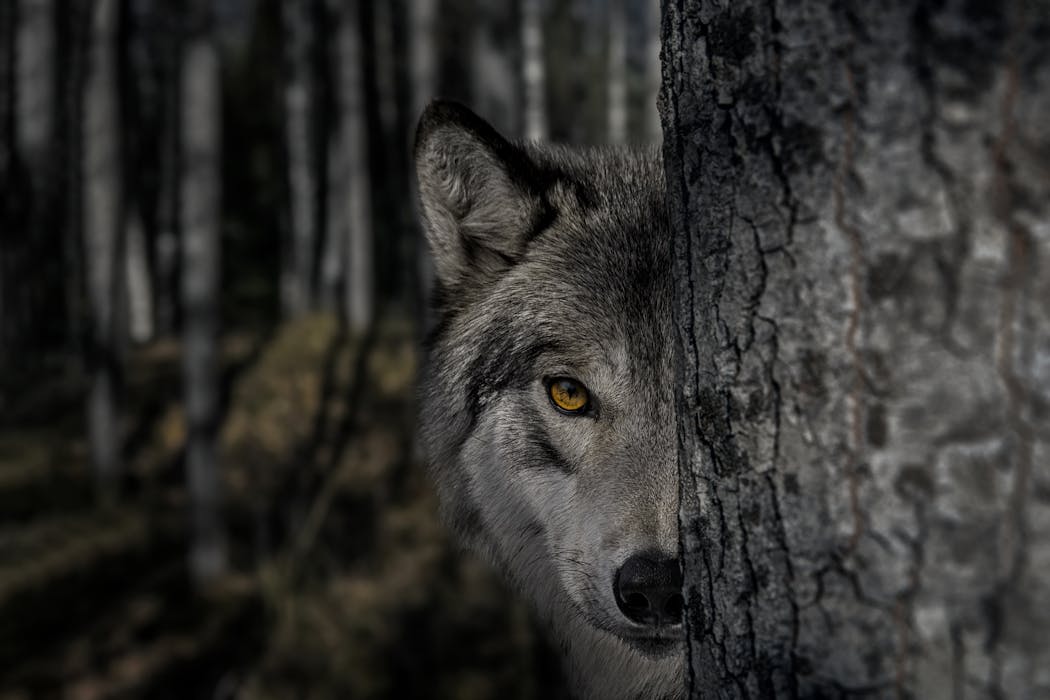
Wolves are returning across Europe – but not to the UK and Ireland, where public support is lukewarm at best. Ecologists point out their benefits, while farmers worry about their livestock. But another influence on public opinion is rarely discussed: Hollywood’s obsession with the wolf as a monster.
This is a particular issue in places where wolves are native yet have been extinct for centuries. Though wolves once roamed across Britain and Ireland, for most people there today they exist only in stories or on screen. The tropes we absorb through entertainment can carry far more weight than scientific facts, and have an outsized impact on how we think and feel about these animals.
Think of the big bad wolf or Little Red Riding Hood. Nearly every child in the English-speaking world is introduced to the villainous wolf from a young age. They’re cunning, cruel and ravenous.
However, we don’t leave that imagery behind us in childhood. Horror cinema keeps our nightmares full of wolves, drawing on familiar – and often entirely false – tropes. Recent films offer some particularly clear examples.
In Guillermo Del Toro’s recent adaptation of Frankenstein, wolves are depicted as villains. After escaping Dr Frankenstein, the monster takes refuge in an isolated farmstead and tries to help its residents. Twice, wolves descend on the farmstead – not only taking sheep but breaking into the house and attacking humans.
During the first attack, the monster muses that “the hunter did not hate the wolf. The wolf did not hate the sheep. But violence felt inevitable between them. This was the way of the world. It would hunt you and kill you, just for being who you are.” Del Toro uses wolves as a metaphor for the world’s brutality. To make that connection, he depicts conflict between wolf and human as “inevitable”, along with portraying wolves – very inaccurately – as determined home invaders.
This negative portrayal is not drawn from Mary Shelley’s novel, which contains no such scenes. Del Toro appears to have inserted it to heighten tension and scare viewers.
Metaphors and monsters
Robert Eggers’s Nosferatu offers another recent big budget example. When Nicholas Hoult’s character tried to escape the vampire Count Orlok’s castle, he is pursued by a pack of wolves. This is very close to older fairytale wolf characters, depicted as overtly evil or demonic.
This was reinforced by the film’s promotional campaign. In a widely reported interview, Hoult claimed he was “nearly attacked” by “real wolves”. In fact, the animals involved were Czech shepherd dogs who played their roles a little too convincingly – not wolves at all. Horror producers sometimes play up events like this to heighten the sense of threat and drum up ticket sales, in this case using an erroneous wolf attack to do so.
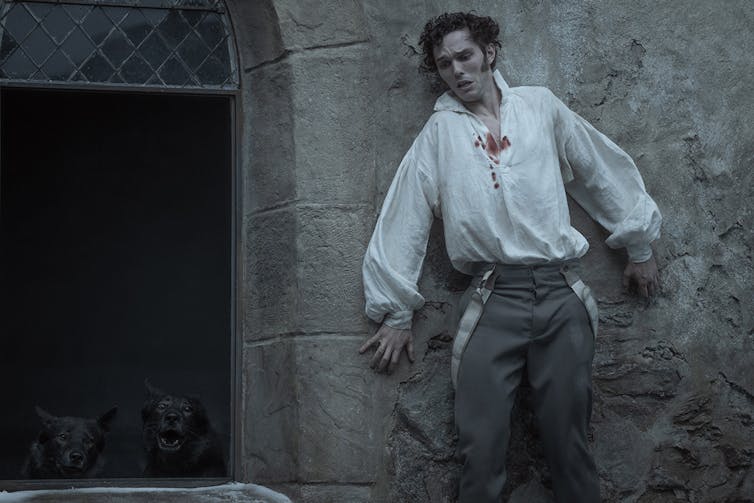 Hoult narrowly escapes the Czech shepherd dogs.
Aidan Monaghan/Universal Pictures
Hoult narrowly escapes the Czech shepherd dogs.
Aidan Monaghan/Universal Pictures
This isn’t limited to big budget cinema. A recent independent horror, Out Come The Wolves, shows two men and a woman who are attacked by wolves on a weekend getaway. Meanwhile, a menacing love triangle plot plays out in which a jealous would-be lover abandons his competition to a wolf attack.
The behaviour of wild predators is presented as an allegory for an opportunistic approach to romance. All’s fair in love and wolves. The film also contains an explicit reference to wolf reintroduction: when hearing about the wolf attack, one character is sceptical, saying “there haven’t been wolves in this area for years!” The message here is clear: as wolves come back to a landscape, so does the danger of attack.
Each of these films draws on existing tropes and fears in slightly different ways. This is what horror does as a genre: works with what scares us already and amplifies it for entertainment. But, in doing so, as high profile cinema events, they risk playing into inaccurate public perceptions. And because most people in Britain and Ireland will never encounter a wolf in the wild, these fictional wolves become their reference points.
On screen v reality
There are valid concerns around wolves preying on sheep, calves or other livestock, but attacks on humans are extremely rare. A pack of wolves surrounding and repeatedly terrorising a home simply doesn’t happen.
There is a strong ecological case for reintroducing wolves where they once lived. As apex predators they reduce populations of deer and other animals which can otherwise damage the environment, often by overgrazing. In Yellowstone national park in the US, grey wolf reintroductions triggered a cascade of unexpected biodiversity benefits, as overgrazing elk were forced on the move, trees recovered, rivers stabilised and beaver populations grew.
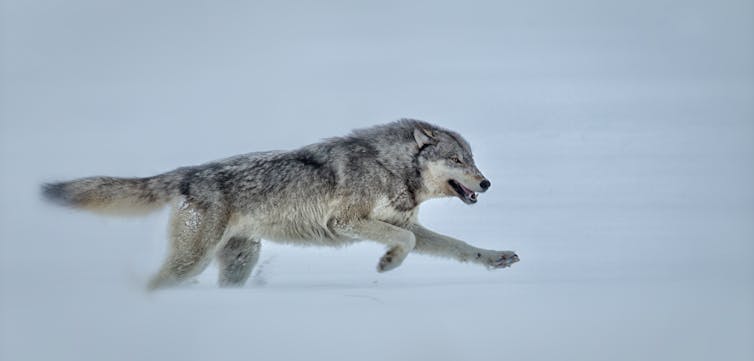 When wolves were reintroduced to Yellowstone, scientists had an ‘almost unique’ chance to study what happens when an ecosystem becomes whole again.
Agnieszka Bacal / shutterstock
When wolves were reintroduced to Yellowstone, scientists had an ‘almost unique’ chance to study what happens when an ecosystem becomes whole again.
Agnieszka Bacal / shutterstock
The same is happening in Europe as wolves spread back into their original range. But to reintroduce wolves to the UK or Ireland, conservationists would have to physically transport them there. Opinion polls show approval rates of 52% in Ireland and just 36% in the UK.
It’s hard to extract these numbers from the cumulative effect of centuries of storytelling, from ancient folklore through Victorian gothic novels to modern Hollywood horror. They all contribute to the idea that wolves are dangerous, unpredictable, and should be nowhere near humans.
It’s meant as entertainment. But horror’s ongoing reliance on the wolf as a symbol of evil or violence may be damaging efforts to promote coexistence with healthy wild populations. Our natural landscapes need wolves. And right now, wolves need all the good PR they can get.

Don’t have time to read about climate change as much as you’d like? Get a weekly roundup in your inbox instead. Every Wednesday, The Conversation’s environment editor writes Imagine, a short email that goes a little deeper into just one climate issue. Join the 47,000+ readers who’ve subscribed so far.
- Wildlife conservation
- Wolves
- Rewilding
- Frankenstein
- Human-wildlife conflict
- Nosferatu
- climate storytelling
Events
Jobs
-
 Senior Lecturer, Clinical Psychology
-
University Lecturer in Early Childhood Education
-
Case Specialist, Student Information and Regulatory Reporting
-
Lecturer in Paramedicine
-
Associate Lecturer, Social Work
 Senior Lecturer, Clinical Psychology
 University Lecturer in Early Childhood Education
 Case Specialist, Student Information and Regulatory Reporting
 Lecturer in Paramedicine
 Associate Lecturer, Social Work
- Editorial Policies
- Community standards
- Republishing guidelines
- Analytics
- Our feeds
- Get newsletter
- Who we are
- Our charter
- Our team
- Partners and funders
- Resource for media
- Contact us
-
-
-
-
Copyright © 2010–2025, The Conversation