
- Home
Edition
Africa Australia Brasil Canada Canada (français) España Europe France Global Indonesia New Zealand United Kingdom United States Edition:
Global
Edition:
Global
- Africa
- Australia
- Brasil
- Canada
- Canada (français)
- España
- Europe
- France
- Indonesia
- New Zealand
- United Kingdom
- United States
Academic rigour, journalistic flair
 Darren England/AAP
Will the government’s new gas reservation plan bring down prices? Yes, if it works properly
Published: December 4, 2025 4.20am GMT
Samantha Hepburn, Deakin University
Darren England/AAP
Will the government’s new gas reservation plan bring down prices? Yes, if it works properly
Published: December 4, 2025 4.20am GMT
Samantha Hepburn, Deakin University
Author
-
 Samantha Hepburn
Professor of Law, Deakin University
Disclosure statement
Samantha Hepburn does not work for, consult, own shares in or receive funding from any company or organisation that would benefit from this article, and has disclosed no relevant affiliations beyond their academic appointment.
Partners

Deakin University provides funding as a member of The Conversation AU.
View all partners
DOI
https://doi.org/10.64628/AA.c6x7hgfx4
https://theconversation.com/will-the-governments-new-gas-reservation-plan-bring-down-prices-yes-if-it-works-properly-271290 https://theconversation.com/will-the-governments-new-gas-reservation-plan-bring-down-prices-yes-if-it-works-properly-271290 Link copied Share articleShare article
Copy link Email Bluesky Facebook WhatsApp Messenger LinkedIn X (Twitter)Print article
The Australian government is poised to introduce a new domestic gas reservation policy on the east coast. The plan is meant to tackle growing concerns around spiking gas prices and domestic supply. Large gas producers in Queensland export the vast majority of their gas to overseas buyers and long-reliable wells in Bass Strait are running empty.
While details are still forthcoming, the broad brushstrokes are clear. Gas reservation policies work because, in this instance, they require east coast liquefied natural gas (LNG) producers to reserve specific volumes for domestic use rather than exporting them.
It’s not unexpected. The government flagged the need for major reform following a sector-wide review of the gas market. Domestic gas prices have tripled in a decade as producers focus on export markets. Price rises have hit big users hard and driven up power prices, as gas is now the most expensive way to produce electricity.
High gas prices have pushed the government to bail out gas-reliant smelters and steelworks. Price shocks have forced industries and households to look for cheaper electric options.
The move comes after Australia’s energy market operator warned the east coast will soon face a gas shortfall.
If designed appropriately, the policy has a real chance of forcing exporters to boost domestic supply. This could cut the link between domestic gas prices and much higher global LNG prices. Something has to be done – gas supply stress is real and worsening. It won’t address all market and infrastructure issues facing the east coast gas market, such as a shortage of pipeline capacity linking Queensland and the southern states.
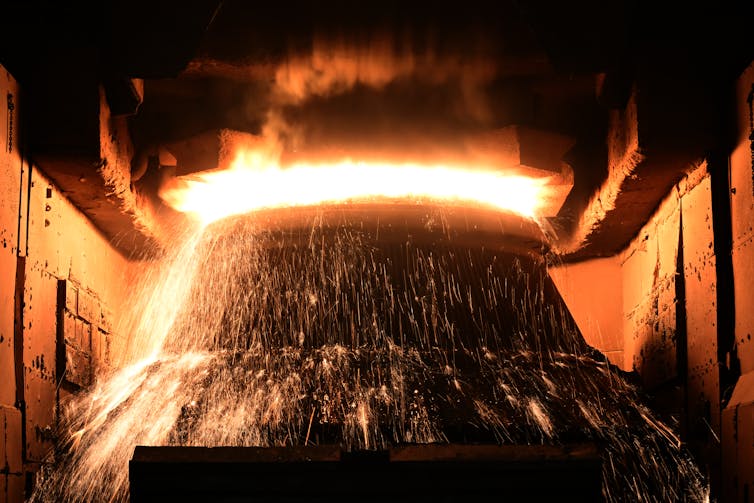 Spiking gas prices have hit big users such as steelworks hard – and prompted some industries to look for electric alternatives.
Dean Lewins/AAP
Spiking gas prices have hit big users such as steelworks hard – and prompted some industries to look for electric alternatives.
Dean Lewins/AAP
What would a gas reservation policy look like?
After an energy crisis in the 1980s, Western Australia introduced its own gas reservation policy which required producers to reserve 15% of gas for domestic use.
But no such scheme has applied on the east coast. Instead, there’s been a mix of regulatory reforms, voluntary industry deals and state-level proposals. Former Liberal leader Peter Dutton took a plan to reserve gas to this year’s election, though it lacked detail on the mechanics, infrastructure constraints and who would bear the costs.
What the Albanese government is proposing would apply only to the east coast, which has a separate gas network, and only to gas that hasn’t already been committed under long-term export contracts.
The proposed scheme would likely build on existing regulatory frameworks such as the Australian Domestic Gas Security Mechanism and Mandatory Gas Code, but would apply more directly to east-coast exporters which are largely located in Queensland.
The plan is to link the new scheme to a broader regulatory overhaul as part of the government’s Future Gas Strategy launched last year. The strategy is meant to ensure gas remains affordable and to manage supply and demand as Australia shifts to clean energy.
Three pillars
While full details are yet to be announced, we know there will be three main elements: a mandatory reservation volume, a gas security incentive, and competitive domestic pricing.
The mandatory reservation will require gas producers to reserve a portion of their supply for the domestic market, likely to be around 50–100 petajoules in its first year of operation. That would represent roughly 10–20% of the 520PJ burned in gas power stations as of 2021–22.
Efforts by previous governments have been voluntary. This will be mandatory, forcing producers to reserve a specific percentage for the domestic market. Once introduced, the scheme will significantly increase dwindling east coast supplies.
The gas security incentive is a strategic move to encourage producers to offer more gas on the domestic market. It will likely work by levying a charge to gas exports, excluding those under long-term contract. The charge is, however, a temporary measure and when a producer fulfils its annual obligation to supply gas to the domestic market, the levy will be returned to them.
The scheme is likely to include competitive domestic pricing to ensure domestic purchasers can buy gas at prices that reflect the cost of production rather than the substantially higher international export prices. This is likely to stabilise gas prices and significantly reduce our dependence on volatile international markets.
Who bears the cost?
Gas producers are not likely to be happy, given they will have to sell gas more cheaply. The peak oil, gas and coal body, Australian Energy Producers, has previously warned against interventionist policies such as mandatory reservation schemes. It says there is a risk of undermining investor confidence and discouraging exploration and production.
The government doesn’t seem concerned about these claims. Rising energy prices have a political cost. Well-designed mandatory reservation scheme will go some way to tackling cost-of-living issues by improving domestic supply security and alleviating some price pressures.
It makes sense to take advantage of Australia’s enormous gas reserves and tackle the looming shortfall and pricing concerns. Disconnecting the domestic east coast market from global LNG price volatility is rational.
Ideally, the forthcoming scheme will form just part of a broader structural overhaul of the gas market including infrastructure, contracting, investment incentives and demand-management reforms.
- Energy
- Gas
- Environment
- Liquefied natural gas (LNG)
- gas reservation policy
Events
Jobs
-
 Respect and Safety Project Manager
-
Associate Dean, School of Information Technology and Creative Computing | SAE University College
-
Senior Lecturer, Clinical Psychology
-
University Lecturer in Early Childhood Education
-
Case Specialist, Student Information and Regulatory Reporting
 Respect and Safety Project Manager
 Associate Dean, School of Information Technology and Creative Computing | SAE University College
 Senior Lecturer, Clinical Psychology
 University Lecturer in Early Childhood Education
 Case Specialist, Student Information and Regulatory Reporting
- Editorial Policies
- Community standards
- Republishing guidelines
- Analytics
- Our feeds
- Get newsletter
- Who we are
- Our charter
- Our team
- Partners and funders
- Resource for media
- Contact us
-
-
-
-
Copyright © 2010–2025, The Conversation


