- News
Two recent killings — one of an outspoken representative of the lime growers, the other a popular mayor standing up to the cartels — in Mexico's western Michoacan state have sent a clear message that organized crime is in charge, something residents have known for years
Mara Verza,Fernanda PesceThursday 04 December 2025 05:10 GMTHow 2 killings exposed the depths of cartels' grip in Mexico's Michoacan state
Show all 5

For free real time breaking news alerts sent straight to your inbox sign up to our breaking news emails
Sign up to our free breaking news emails
Sign up to our free breaking news emails
Email*SIGN UPI would like to be emailed about offers, events and updates from The Independent. Read our Privacy notice
On a steamy night, a farmer from a village of modest tin-roofed homes surrounded by rolling lime orchards in western Mexico’s coastal mountains approached Rev. Gilberto Vergara for help.
The drug cartels were extorting him and other growers so heavily that the math no longer worked to harvest all his limes, the burly farmer told him tearfully after Mass. Authorities did nothing, he lamented. Residents were afraid speaking up was a death sentence but staying silent meant starving.
Two recent killings — one of an outspoken representative of the lime growers, the other a popular mayor standing up to the cartels — have made a long-known truth impossible to ignore: Organized crime controls much of Michoacan and its economy.
Now as U.S. President Donald Trump has launched military attacks against alleged drug-smuggling boats in the Caribbean and the Pacific and has offered to send the U.S. military to Mexico, President Claudia Sheinbaum faces increased pressure to solve a puzzle no other leader has been able to. But years of failed tactics have left residents skeptical that the government will offer a solution.
The priest did not expect much from authorities, but told the farmer he would try to speak to them.
Later, Vergara still in his white cassock, drove home into the darkness of Tierra Caliente along cartel-controlled roads with the risk of land mines planted in the hills or drone attacks.
The cartels “have the state in their hands,” the priest said.
‘He was fighting for us’
Carlos Manzo, the 40-year-old mayor of Uruapan in western Michoacan, was in his town’s central square amid hundreds gathered for Day of the Dead festivities when a teenage gunman shot him seven times despite his 22-person security detail, including National Guardsmen.
The criminals' message was clear: We can get anyone.
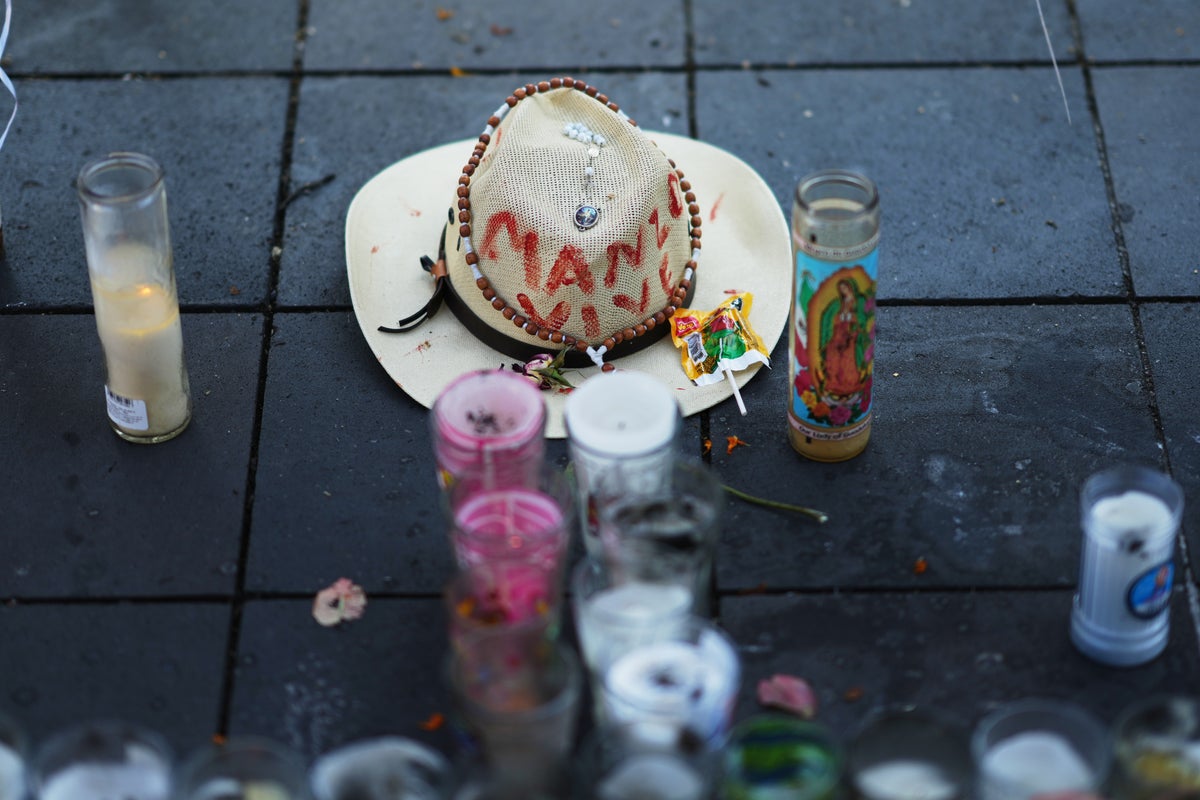
Weeks later, the crime scene remained blocked off. Candles and wilted marigolds sat inside. Hundreds of handwritten messages demanding justice hung outside.
Manzo, a former congressman for Sheinbaum’s Morena party turned critic, was seen throughout Michoacan as the only politician trying to eradicate the drug cartels. He had run corrupt cops off the local police force, touted arrests of narcos on social platforms and earned a reputation for going into the most dangerous corners to talk to anyone. In October, he appealed to the federal government for help.
“It felt like he was fighting for us,” said Imelda Peña, a 42-year-old teacher, who criticized Sheinbaum for her perceived weakness on organized crime, although the president strengthened the federal security strategy when she came to power. “I hope this is a tipping point.”
A message that resonated
Uruapan residents called Manzo “the Mexican Bukele” after El Salvador’s millennial president with a no-holds-barred approach to his country’s street gangs. Some saw Manzo as a potential gubernatorial candidate who could pry Michoacan back from Morena with his own political movement, but his message confronting the cartels resonated nationwide.
Investigators have linked his killing to the powerful Jalisco New Generation Cartel, but who ordered it and why remains unclear. The gunman was shot when he was already on the ground. Seven of the nine charged so far in case were Manzo's bodyguards.
The office of Manzo's widow Grecia Quiroz, who became mayor after his death, did not respond to numerous requests for comment.
An hour’s drive west of Apatzingan in La Ruana, Guadalupe Mora, another outspoken critic of the government’s security policies, stood among his own 20-person security detail, requested after Manzo’s killing. His brother Hipólito Mora, founder of farmer self-defense groups more than a decade earlier, was killed two years ago.
“It seems like we made the government and organized crime uncomfortable, that’s why they’re killing us,” Guadalupe Mora said.
Where plans fail
Michoacan has stymied presidents before and has become one of Sheinbaum's biggest challenges. All strategies to pacify the state over the last 20 years have failed while criminal groups have multiplied and renewed their tactics.
At least three of the six drug cartels that the Trump administration designated as terrorist organizations — Jalisco New Generation, United Cartels and The New Michoacan Family — operate here, in addition to a slew of homegrown armed splinter groups, some supported by the Sinaloa Cartel.
They drop bombs from drones, use 3D-printed grenade launchers, hide improvised explosive devices and erect surveillance cameras, according to state officials. They suffocate all economic sectors with extortion, a business as lucrative as drugs.
Manzo’s killing set off protests across Michoacan and in Mexico City. In Uruapan, graffiti accused authorities of involvement. The president’s popularity threatened to plummet for the first time in just over a year in office.
So she announced an additional 2,000 troops — on top of the 4,300 permanent ones and 4,000 in neighboring states — and government spending that sounded reminiscent of failed plans past.
The difference, the government says, is coordination and intelligence. Cutting the political links of the cartels is the final missing piece.
The U.S. government is watching because Michoacan is a key importer of chemical precursors for synthetic drugs. In the last two months, 17 drug laboratories were dismantled by Mexican authorities. Michoacan also supplies the avocados for Americans’ insatiable guacamole habit, made more expensive by extortion.
Immediately after the killing, U.S. Deputy Secretary of State Christopher Landau wrote on social platform X: “May his memory inspire prompt and effective action.”
Many here say that if it takes pressure from Washington to make Mexican authorities act, then so be it.
Security analyst David Saucedo expects a targeted campaign against small but very violent cartels in the state but that could mean strengthening the most powerful Jalisco cartel.
Vergara, the priest, blamed past and current administrations for failing to follow their security policies through.
“Michoacan is the sum of past mistakes, ” Vergara said. “They’re not committed enough to implement (their plans) no matter the cost.”
‘Endless war’
In the orchard blanketed hills, the front lines are constantly shifting as one group arrives, seizes a house for its command post and starts fighting, leaving residents to believe peace will come when one group dominates. Among the crowded field of criminal groups, civilians often have no idea who is who, and confusion multiplies fear.
A woman who requested anonymity for her safety said that various groups fight for control of the area where she lives and until one has it, it's constant fighting.
She fled her home in March with her family and all their neighbors. They were not safe in their tin-roofed homes, even under their beds, she said. They could hear mines explode when animals walked over them, making people afraid to go into the fields.
The woman’s family returned when the army arrived, except for her 19-year-old son who she sent to the United States because she feared a cartel would snatch him.
She knows the soldiers will eventually leave and it makes her furious to hear the government say that things are improving. The morning she spoke with the AP an elderly man was wounded when he rode over a mine on a motorcycle.
Loss of leaders
Without these slain leaders standing up to the cartels, residents wonder who will take up this fight.
In some Indigenous communities in the north of the state, such as Sevina, organized crime has arrived in trucks, stormed guard posts and intimidated authorities. Villagers have mounted their own defense and organized forest patrols, after losing faith in federal forces. Success is not guaranteed, even though some neighboring towns achieved it.
Meanwhile, cartels continue stifling the local economy controlling the price of limes in the South despite the recent deployment of 800 soldiers to protect the producers.
The grower who came to see Vergara said he is paid half the amount he needs to produce each kilo of limes, so he and others are taking orchards out of production.
Bernardo Bravo, their representative killed two weeks before Manzo, called it “permanent commercial kidnapping” and organized protests denouncing it. Now the growers have nobody to speak up for them.
“We don’t see a resolution," the farmer said. "The criminals are squeezing us tight.”