- News
- Business
Ms Reeves is widely expected to pull the lever on tax hikes in order to fill a black hole in the public finances as she delivers her second budget.
PaWednesday 26 November 2025 11:59 GMT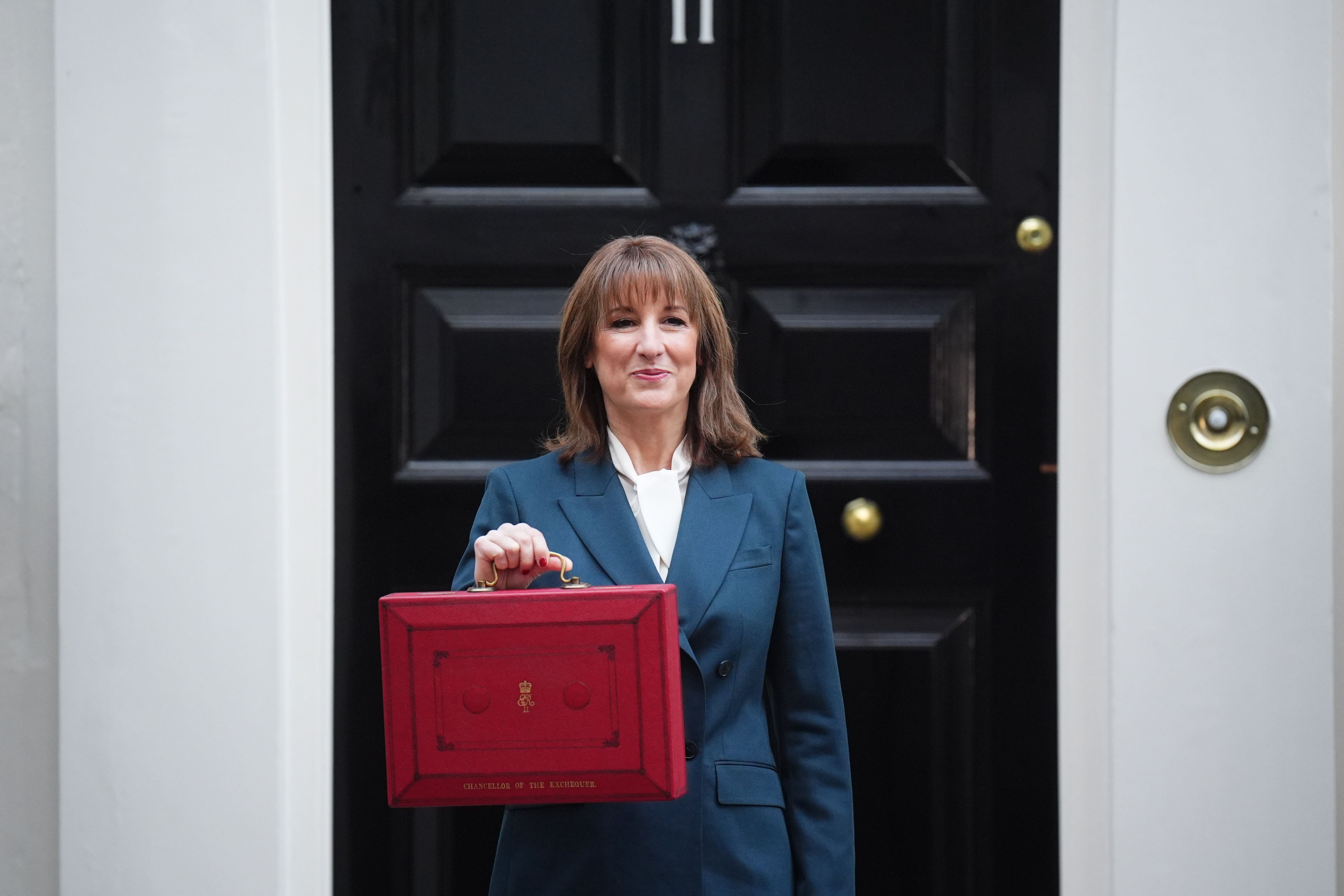 open image in galleryChancellor Rachel Reeves poses outside 11 Downing Street, London, with her ministerial red box, before delivering her Budget in the House of Commons (James Manning/PA) (PA Wire)
For free real time breaking news alerts sent straight to your inbox sign up to our breaking news emails
Sign up to our free breaking news emails
Sign up to our free breaking news emails
Email*SIGN UPI would like to be emailed about offers, events and updates from The Independent. Read our Privacy notice
Chancellor Rachel Reeves is widely expected to pull the lever on tax hikes in order to fill a black hole in the public finances when she delivers her second budget in the House of Commons.
Ms Reeves has said the Budget will focus on three priorities: cutting the cost of living, cutting NHS waiting lists and cutting the cost of debt.
- Chancellor Rachel Reeves said she 'will take the fair and necessary choices to deliver on our promise of change' when she delivers the Budget in the House of Commons
- The Chancellor is reportedly going to adopt what is being called a 'smorgasbord' approach to raising taxes at the Budget
- The National Living Wage will rise from next April by 4.1% to £12.71 an hour for eligible workers aged 21 and over
- The National Minimum Wage rate for 18 to 20-year-olds will increase by 8.5% to £10.85 an hour
The Chancellor is said to be facing a more difficult economic outlook in the medium term, with reports that the Office for Budget Responsibility has downgraded its growth forecast for 2026 and every other year before the next election due in 2029.
12pm
Farmers brought their tractors to London to protest over a number of measures, including inheritance tax changes.
11.55am
As the Chancellor’s Budget statement nears, here is what we know so far:
– Income tax: After a press conference and behind-the-scenes briefings aimed at preparing the country for a manifesto-busting increase in income tax, Rachel Reeves then abandoned the idea of becoming the first Chancellor in half a century to take that step.
Instead, she may now opt for extending the existing freeze on the income tax thresholds, which, if she also kept national insurance thresholds at their current rate, would raise around £8.3 billion a year for the Exchequer in 2029/30.
– Increase in minimum wage: The Government has announced this week that minimum wage rates will increase next year, giving a pay rise to millions of workers.
From next April, the National Living Wage will rise by 4.1% to £12.71 an hour for eligible workers aged 21 and over, which the Government said will increase gross annual earnings of a full-time worker on the rate by £900, benefiting around 2.4 million low-paid workers.
The National Minimum Wage rate for 18 to 20-year-olds will increase by 8.5% to £10.85 an hour, narrowing the gap with the National Living Wage.
For 16 to 17-year-olds and those on apprenticeships, the National Minimum Wage will increase by 6% to £8 an hour.
– Rail fares: They will be frozen in the Budget, saving commuters on pricier routes more than £300 a year.
– Prescriptions: The cost of an NHS prescription in England will be frozen at £9.90.
– Freezing fuel duty: According to reports, Ms Reeves will announce she is retaining the 5p cut in fuel duty, which was introduced in 2022, and ensure it does not rise in line with inflation.
– EV buyer subsidy: She will add £1.3 billion to a grant that knocks up to £3,750 off the price of an electric vehicle as part of a package that will also see £200 million go towards the rollout of charging points.
– Tax hike on high-value homes: A new levy could be applied to some of the most valuable homes in what has been billed by some as a “mansion tax”.
The move would reportedly revalue some of the most valuable properties across council tax bands F, G and H and hit 100,000 of them with a new surcharge, with the threshold starting at £2 million.
– Salary sacrifice: The Chancellor might introduce limits on how much employees can stash in their pensions under salary sacrifice schemes before it becomes subject to national insurance.
– Two-child benefit cap: As pressure has piled up, Ms Reeves is expected to scrap the limit that restricts child tax credit and universal credit to the first two children in most households.
– Crackdown on benefits fraud: The Chancellor will seek to raise £1.2 billion by March 2031 by extending a crackdown on fraudulent and mistaken universal credit payments via the targeted case review scheme.
– Tourism tax: Visitors to English cities and regions could face paying a new tourist tax to fund local projects as the Government has announced mayors will be given the power to impose a “modest” charge on visitors staying in hotels, bed and breakfasts, guest houses and holiday lets.
– Sugar tax on pre-packaged milkshakes and lattes: Health Secretary Wes Streeting announced this week that these products will be subject to the sugar tax, ending the exemption for milk-based beverages from the existing tax on sugary drinks.
The move will affect products such as packaged milkshakes, coffees and sweetened yoghurt drinks, but not drinks made on site in cafes and restaurants.
– Cash Isa limit cut: According to reports, Ms Reeves may reduce the annual cash ISA limit from £20,000 to £12,000.
11.48am
Farmers are not the only ones who have been making their point with eye-catching protests in the political heart of London – these creative campaigners called on the Chancellor to bring in a wealth tax.
11.46am
The “riot act” has been read to parliamentarians and Government insiders responsible for leaking elements of the Budget, Chief Secretary to the Prime Minister Darren Jones said.
The lead-up to Rachel Reeves’ statement has been characterised by a flurry of leaks and speculation about the contents of her statement.
Mr Jones told LBC Radio: “There have been some leaks which are unacceptable and not very helpful.
“We’ve had to read the riot act to people in Government about that.”
11.43am
Farmers have made their feelings clear ahead of the Chancellor’s statement, bringing tractors to a Budget day protest against proposed inheritance tax changes, despite a police ban on agricultural machinery in Westminster.
More than a dozen tractors could be seen parked outside Parliament on Wednesday morning, with rush-hour traffic brought to a standstill and farmers repeatedly sounding the tractor horns while police stood watching.
The Metropolitan Police said said the decision to ban agricultural machinery from Whitehall had been taken because of “serious disruption” the vehicles may cause to the local area, including businesses, emergency services and the public.
David Gunn, an arable farmer and agricultural contractor from near Sevenoaks in Kent, said he was protesting on Budget day for a number of reasons, including the Government move to put inheritance tax on larger farm businesses.
He said: “Inheritance tax is one reason, it’s going to cripple the farmers, the small family farmers.
“There’s all the other taxes they’ve been putting on us, and the prices we get for our produce and what it costs in the shop, we don’t make any money.
“Then there’s food security, farmers are going out of business.”
11.35am
Chancellor Rachel Reeves has just emerged from 11 Downing Street with the famous red box on Budget day.
11.30am
Rachel Reeves acknowledged people are “angry at unfairness” in the British economy in a filmed address ahead of the Budget.
The Chancellor said the Government had started to see results in the past year, with “wages rising faster than inflation, hospital waiting lists coming down and our economy growing faster and stronger than people expected”.
“But I know there is more to do,” she said.
“I know that the cost of living is still bearing down on family finances, I know that people feel frustrated at the pace of change, or angry at the unfairness in our economy.
“I have to be honest that the damage done from austerity, a chaotic Brexit and the pandemic were worse than we thought.”
11.25am
Ahead of the statement in the Commons, it was announced that the National Living Wage will rise from next April by 4.1% to £12.71 an hour for eligible workers aged 21 and over, and the National Minimum Wage rate for 18 to 20-year-olds will increase by 8.5% to £10.85 an hour.
Hover over this interactive graphic to see how much the minimum wage has increased by since 1999.
Elsewhere, mayors in England will be given the power to impose a “modest” charge on visitors staying in hotels, bed and breakfasts, guest houses and holiday lets – dubbed a tourist tax.
The money raised is intended to be invested in transport, infrastructure and the visitor economy to potentially attract more visitors.
