 Getty Images
 Moneywise and Yahoo Finance LLC may earn commission or revenue through links in the content below.
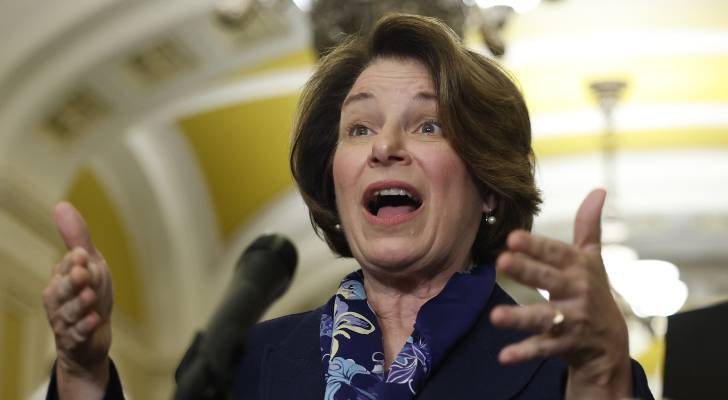
Rising living costs remain a pressing issue for Americans — and Senator Amy Klobuchar (D–MN) is trying to place the blame on President Donald Trump, with a particular focus on electricity prices.
“Under President Trump, electricity prices are surging — up 11%! — leaving millions behind on their utility bills, with past-due balances at an all-time high,” Klobuchar wrote in a recent post on X, adding that “American families deserve better (1).”
Must Read
-
Thanks to Jeff Bezos, you can now become a landlord for as little as $100 — and no, you don't have to deal with tenants or fix freezers. Here's how
-
Dave Ramsey warns nearly 50% of Americans are making 1 big Social Security mistake — here’s what it is and 3 simple steps to fix it ASAP
-
Approaching retirement with no savings? Don’t panic, you're not alone. Here are 6 easy ways you can catch up (and fast)
Her post featured a chart titled “Average past-due utility balances are at an all-time high,” showing a steep climb in overdue bills in the U.S. in recent years, based on calculations from the Century Foundation.
But the post quickly backfired.
Users on X noted that the chart’s data begins in 2022 — and that most of the increase in average past-due balances occurred between 2022 and late 2024, when Joe Biden was in office.
“Do you notice the spike during the Joe Biden years?” one top comment read (2).
According to The Century Foundation, using the University of California Consumer Credit Panel, the average overdue utility balance in the U.S. was $597.21 in Q1 2022 (3). By Q1 2025 — when Trump took office — that figure had already climbed to $774.52. It ticked up again to $788.83 in Q2 2025.
Others pointed out that the chart didn’t actually measure electricity prices — the basis of Klobuchar’s criticism — but rather average past-due balances.
Still, Klobuchar may have been referring to a separate update from the National Energy Assistance Directors Association (NEADA), which recently reported that electric prices are up 10.5% since January 2025 (4).
And while the social-media misstep has drawn plenty of attention, the broader reality remains: Electricity costs have surged, and utility pressure on households has intensified — regardless of who sits in the White House.
NEADA data also shows that residential electricity prices rose 27.9% between 2021 and 2025, while the average monthly residential bill jumped 28.8%.
And utility bills aren’t the only pain point. Everything from food and housing to transportation and healthcare has become more expensive. The overall consumer price index is up 25% since 2020.
Story ContinuesThe challenge with electricity is that consumers often have limited control — many regions have only one provider, and usage isn’t always flexible. But the good news is that there are other areas where your dollar can stretch further. Not by skipping lattes or cutting all indulgences, but by identifying essential categories where you may be overspending.
With the right tools and a bit of research, many of those costs can be meaningfully reduced.
This everyday expense has jumped 55% — here’s how to cut it
One essential expense that has skyrocketed in recent years is car insurance. Nationwide, the average cost of car insurance has surged 55% since 2020, according to the Bureau of Labor Statistics (5).
Car insurance is a major recurring expense and many people overpay without realizing it. According to Forbes, the average cost of full-coverage car insurance is $2,149 per year (or $179 per month).
However, rates can vary widely depending on your state, driving history and vehicle type. You could be paying more than necessary.
By using OfficialCarInsurance.com, you can easily compare quotes from multiple insurers, such as Progressive, Allstate and GEICO, to ensure you’re getting the best deal.
In just two minutes, you could find rates as low as $29 per month.
And it’s not just your car that might be costing you more than it should. Home insurance costs have also risen — and it’s another major expense where smart shoppers can save big (6).
With OfficialHomeInsurance, comparing home insurance rates is fast and hassle-free. Just fill in a bit of information, and the platform will sort through over 200 insurers to find the best deals available in your area.
You’ll be able to review all your offers in one place and quickly find the coverage you need for the lowest possible cost, saving an average of $482 a year.
Read more: Warren Buffett used 8 solid, repeatable money rules to turn $9,800 into a $150B fortune. Start using them today to get rich (and stay rich)
Don’t let hidden expenses drain your budget
If you want to improve your finances, the first step is understanding where your money actually goes each month. Track every expense for 30 days and sort them into two categories: essentials — like rent, groceries, utilities and healthcare — and discretionary spending, such as dining out, entertainment, shopping and hobbies.
This breakdown not only shows you where your money is going, but also highlights the hidden leaks — the forgotten subscription, the auto-renew you didn’t notice, or the small impulse purchases that quietly add up.
The good news is you don’t have to manage all of this on your own. Apps like Rocket Money can simplify the process.
Rocket Money tracks and categorizes your expenses, providing a clear view of your cash, credit and investments in one place. It can even uncover forgotten subscriptions, helping you stop unnecessary payments and save potentially hundreds annually.
For a small fee, the app can also negotiate lower rates on your monthly bills, potentially making it a valuable tool for keeping your finances on track.
You May Also Like
-
Does Class B real estate have a place in your portfolio? Rich investors think so — here’s why, and how it could work for you
-
Dave Ramsey says this 7-step plan ‘works every single time’ to kill debt, get rich — and ‘anyone’ can do it
-
Robert Kiyosaki says this 1 asset will surge 400% in a year — and he begs investors not to miss its ‘explosion’
-
This top market strategist reveals the market trends you can’t ignore — and how to position your portfolio to stay ahead in 2026
Article sources
We rely only on vetted sources and credible third-party reporting. For details, see our editorial ethics and guidelines.
@amyklobuchar (1); @GuntherEagleman (2); The Century Foundation (3); National Energy Assistance Directors Association (NEADA) (4); Bureau of Labour Statistics (5); CBS News (6)
This article provides information only and should not be construed as advice. It is provided without warranty of any kind.
Terms and Privacy Policy Privacy Dashboard More Info